

The UK Recruitment Market Has Risen for the First Time Since 2022

The UK recruitment market showed encouraging signs of improvement in August, with permanent hiring increasing for the first time in almost four years and temporary recruitment continuing to gather momentum.
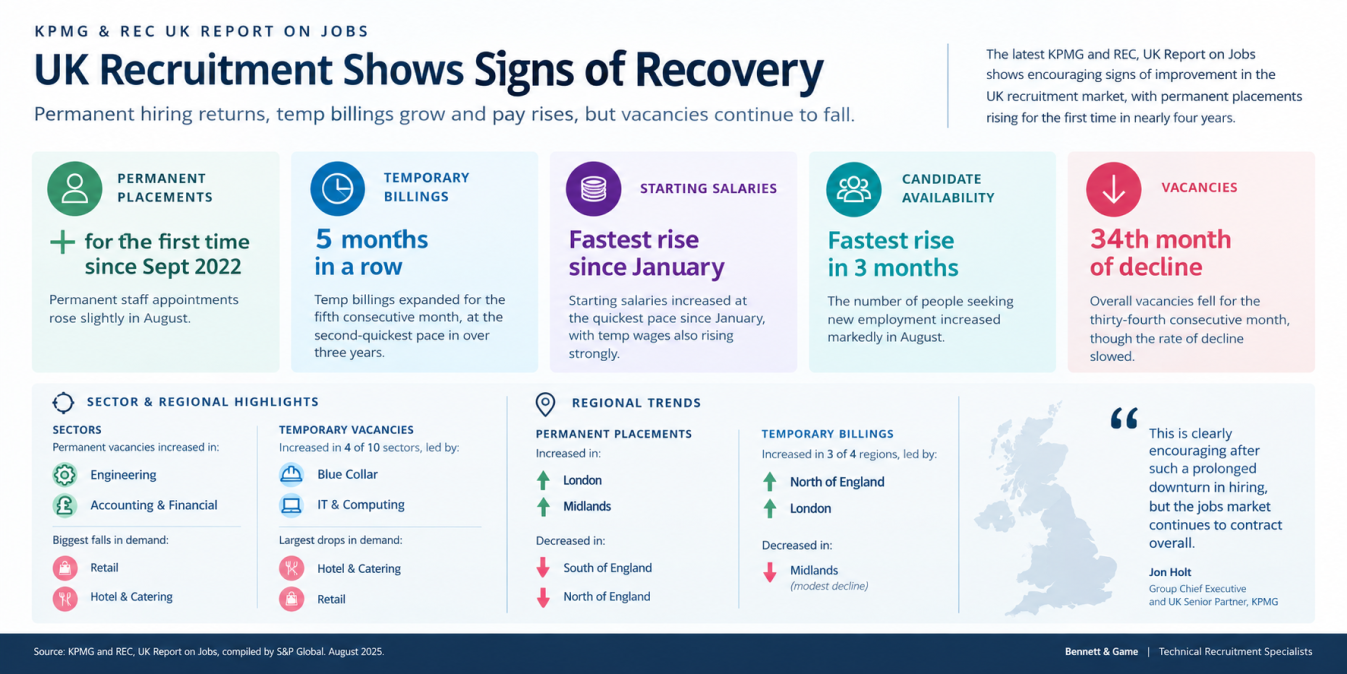
According to the latest KPMG and REC UK Report on Jobs, compiled by S&P Global, it has been reported the first broad-based improvement in hiring trends since 2022. Permanent placements rose slightly during the month, while temporary billings increased for the fifth consecutive month.
Although challenges remain, including falling vacancies and a growing supply of candidates, the latest figures suggest that employer confidence may finally be starting to return.
Permanent Hiring Returns After Nearly Four Years
One of the most significant findings from the August report was the return to growth in permanent staff appointments.
Permanent placements increased for the first time since September 2022, ending a prolonged period of decline across the UK recruitment market.
The increase was modest, with continued economic uncertainty and concerns surrounding government policy still causing some employers to approach recruitment cautiously. However, the rise was linked to improving business confidence and companies looking to increase capacity as they plan for future growth.
While it may be too early to describe this as a full-scale recovery, the return to growth in permanent recruitment is an encouraging development after almost four years of challenging market conditions.
Temporary Recruitment Continues to Build Momentum
Temporary recruitment also remained a key area of growth.
Temp billings increased for the fifth month in a row and at the second-fastest pace seen in more than three years.
The continued growth reflects the increasing appeal of flexible workforce solutions. With many businesses still navigating economic uncertainty, contract and temporary employees can provide the skills and capacity needed without the same level of long-term commitment associated with permanent recruitment.
The report also highlighted a growing volume of contract work, suggesting that employers are continuing to use flexible staffing models to support business activity and investment plans.
For businesses facing uncertainty around demand, budgets or future growth, temporary and contract recruitment can offer an effective way to access specialist skills while maintaining greater flexibility.
Starting Salaries Rise at the Fastest Pace Since January
Competition for highly skilled and specialist professionals continued to put upward pressure on pay.
Recruiters reported a stronger increase in permanent starting salaries during August, with pay rising at the fastest pace since January.
Temporary wages also continued to increase at a strong rate, with growth among the quickest seen over the past two years.
Several factors are continuing to influence salary expectations, including competition for candidates with specialist and niche skills, rising living costs and the ongoing challenge of attracting and retaining experienced professionals.
For employers, the findings reinforce the importance of regularly reviewing salaries and overall reward packages.
While businesses remain conscious of rising employment costs, competitive pay remains a key part of securing the right talent, particularly in sectors where specialist skills are in high demand.
Candidate Availability Continues to Increase
While hiring activity showed signs of improvement, the supply of available candidates continued to rise.
The number of people seeking new employment increased at the fastest pace for three months in August.
Recruiters linked the rise in candidate availability to several factors, including continued redundancies, fewer job opportunities and concerns around job security.
Permanent candidate availability continued to increase more sharply than the supply of temporary workers.
For employers, a larger candidate pool could create more opportunities to access skilled professionals. However, increased availability does not necessarily mean that every vacancy will be easier to fill.
Specialist roles still require specific technical knowledge, qualifications and experience, meaning that skills shortages can continue even when overall candidate numbers are rising.
This is where targeted recruitment and access to established candidate networks can become increasingly important.
Vacancies Continue to Fall, but the Decline Is Showing Signs of Easing
Despite the improvement in placements and temporary billings, overall demand for staff continued to decline.
August marked the thirty-fourth consecutive month of falling vacancies. However, the rate of decline was among the weakest seen in nearly two years.
This could suggest that the market is beginning to stabilise.
Permanent vacancies continued to fall, although the rate of decline remained unchanged from July. Demand for temporary staff also fell following a brief increase during the previous month.
The picture remains mixed, but the slowing rate of decline, combined with the return to growth in permanent placements, provides some encouragement for the months ahead.
Engineering and Finance See Positive Vacancy Growth
The report also highlighted significant differences between sectors.
Permanent vacancies increased in both Engineering and Accounting & Financial roles during August, demonstrating continued demand for skilled professionals within these areas.
However, vacancies declined across the remaining job categories monitored by the survey.
The sharpest falls in demand were once again reported in Retail and Hotel & Catering.
For temporary recruitment, four of the ten monitored sectors reported an increase in vacancies.
Blue Collar and IT & Computing recorded the strongest growth in demand for temporary workers, while Hotel & Catering and Retail saw the largest reductions.
These differences highlight the importance of understanding individual sectors rather than viewing the recruitment market as one single picture.
While some industries remain cautious, others are continuing to invest, expand and compete for specialist talent.
A Mixed Picture Across the UK
Regional recruitment trends also remained varied.
Permanent placements increased in London and the Midlands, while recruitment activity continued to decline across the South and North of England.
Temporary recruitment showed stronger performance across three of the four monitored English regions, with the North of England recording the strongest growth in temporary billings.
The Midlands was the only region to report a fall in temporary recruitment activity, although the decline was modest.
These regional differences demonstrate that recruitment conditions can vary significantly depending on location, sector and the specific skills being sought.
Is Confidence Returning to the UK Jobs Market?
The latest KPMG and REC data paint a cautiously optimistic picture.
Permanent recruitment has returned to growth for the first time since 2022, while temporary hiring continues to perform strongly. Starting salaries and temporary wages are also increasing at a faster pace as businesses continue to compete for skilled professionals.
However, the market is far from fully recovered.
Vacancies are still declining, candidate availability continues to rise and economic uncertainty remains a major factor influencing employer decision-making.
As Jon Holt, Group Chief Executive and UK Senior Partner at KPMG, highlighted, businesses have had to adapt to ongoing uncertainty and build greater resilience into their workforce strategies.
The key question now is whether this renewed activity can develop into sustained growth.
Government policy, borrowing costs and wider economic confidence are likely to play an important role in determining how the recruitment market performs over the coming months.
What Does This Mean for Employers and Candidates?
For employers, the latest figures suggest that now may be the time to review recruitment plans.
Although the overall vacancy market remains challenging, businesses that have delayed hiring may find themselves competing for highly skilled professionals as confidence gradually returns.
Salary expectations are also continuing to rise, particularly for specialist and niche roles. Employers will need to ensure that their salaries, benefits and overall employee offering remain competitive.
For candidates, increased availability means greater competition for some opportunities. However, demand remains strong in certain specialist sectors, including Engineering, Finance, IT and other technical industries.
As the market continues to evolve, both employers and candidates will need to remain flexible and prepared to respond to changing conditions.
Looking Ahead
After a prolonged period of declining recruitment activity, August's data offers some welcome encouragement.
The return to growth in permanent placements, combined with continued strength in temporary recruitment, could indicate that the UK jobs market is beginning to move in a more positive direction.
However, the recovery remains fragile.
Employers are still navigating economic uncertainty, vacancies remain under pressure and candidate availability continues to rise. The coming months will be important in determining whether the positive momentum seen in August can be sustained.
For now, the message is one of cautious optimism.
The recruitment market may not yet be booming, but after nearly four years of difficult conditions, there are finally signs that the hiring landscape could really be starting to turn a corner.
Looking to hire your next member of the team or your next job? Get in touch with our recruitment experts today online or call 01243 378833.
Resources: